The right machine depends less on its advertised heater size than on saleable cones per hour, rolling speed, recipe compatibility and the serving format you plan to sell. By the end, you will have a practical method for comparing capacity, cone dimensions, operating controls, electrical requirements and supplier support before ordering.
Key takeaways
- Calculate output from cavities, cycle time and real production losses.
- Match cone diameter and height to your scoop, display and packaging.
- Test batter dosing, baking temperature, rolling time and seam strength.
- Compare utilities, cleaning time, rejects and supplier support—not capacity alone.
Calculate Saleable Output From the Full Production Cycle
A machine’s theoretical output is (number of cavities × 3,600) ÷ cycle time in seconds. Four cavities running a 30-second cycle therefore produce 480 cones per hour before production losses. Reduce that figure for batter dosing, plate opening and closing, wafer removal, rolling, seam holding, stacking, cleaning, changeovers and rejects.
| Option | What to compare | Practical capacity |
|---|---|---|
| 600-cone catalogue rating | Short bake cycle with continuous plate operation | Saleable output can fall sharply when one operator removes, rolls and stacks each blank |
| Manual commercial waffle cone machine | Cavities versus complete bake cycle and recovery time between plates | Rolling, not baking, often becomes the bottleneck |
| Semi-automatic line | Assisted handling against operator and changeover requirements | Better balance for variable demand and fewer trained operators |
Ask the supplier for cycle time using your batter weight, cone diameter, target wafer colour and wall thickness. Record whether the machine needs one operator or a loader plus a separate rolling operator.
Fresh blanks must reach the cone former immediately; a backlog at the rolling station lets wafers cool, split at the seam and become rejects, even while plates continue running. For a variable waffle cone maker for confectionery in Nagpur, calculate saleable cones from a full trial shift, including cleaning and changeovers.
A high-capacity line suits steady demand only when you can staff and feed it continuously.
Match Cone Size to the Scoop, Display and Pack
A 6-inch cone is correct only when its finished dimensions match your scoop, toppings and pack. Measure the rolled cone, not just the circular baking plate or mould: a flat wafer becomes tapered only after wrapping around a cone former.
| Finished format | Best fit | Main check |
|---|---|---|
| 6-inch cone | One standard scoop, counter service, upright display box | Scoop diameter, fill height, rim strength and topping space |
| Smaller cone | Children’s portions, tasting flights, compact packs and samples | Lower capacity and reduced serving cost |
| Larger cone | Two scoops, layered desserts and premium toppings | Wafer strength under the added weight |
Ask the supplier for the finished height, mouth diameter, tip shape, average mass and wall thickness. A 6-inch specification can describe the plate or blank rather than the usable cone, so confirm the former, moulds, rolling tools and ejecting accessories supplied with the commercial waffle cone machine.
Before choosing a waffle cone maker in Nagpur, test the cone in its actual packaging:
- Place it in the sleeve, carton or display stand and close the pack.
- Check that the rim does not touch the lid and the tip sits securely.
- Confirm whether another size needs replacement plates, a new former or a complete mould change.
Humidity makes this test essential: a cone that fits at the freezer counter but softens in storage is not a usable format.
Control Batter, Temperature and the Hot Rolling Window
Consistent cones start with a batter whose viscosity, hydration, sugar level and fat content stay constant. Rest each batch for the same time before production; sugar controls browning and brittleness, fat supports release and tenderness, while extra water lengthens baking and leaves a softer wafer.
| Control | Set or verify | Failure sign |
|---|---|---|
| Batter | Weigh each deposit; do not rely on a ladle | Unequal diameter or thickness |
| Heat | Check top and bottom plates at several points | Pale edges beside over-browned centres |
| Rolling | Keep the former beside the plates | Split seams, brittle tips or leaks |
Treat 250°C as a specification to verify, not an automatic operating temperature. Confirm the controller setting and measure both plates with a calibrated infrared thermometer before production; a single hot spot can disguise uneven heating.
Run the cycle in this order:
- Weigh the deposit, close the plates and bake until the required colour appears.
- Open the plates without scraping the wafer surface, then lift the blank with heat-resistant handling.
- Transfer it immediately to the cone former while it remains hot and pliable.
- Wrap it around the former, overlap the seam, hold it until set and inspect the tip for leaks.
The wafer hardens quickly, so a distant roller creates cracked cones and a rolling backlog. Record deposit weight, bake time, temperature and reject reason whenever you adjust the recipe.
This routine matters in bakery waffle cone equipment and when selecting a waffle cone maker for confectionery in Nagpur, where repeatability matters more than a short run of attractive samples.
Compare Machine Types, Utilities and Daily Cleaning
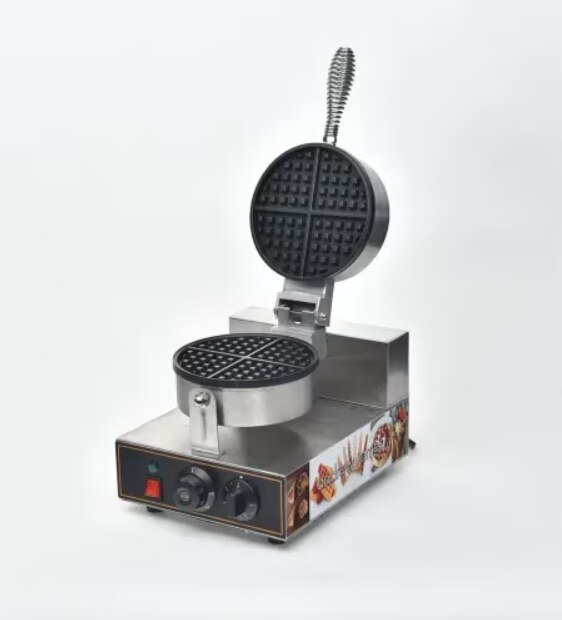
A manual waffle iron costs less to operate, but the operator must dose batter, time baking, release each wafer and roll it before it hardens. A commercial waffle cone machine reduces handling and improves repeatability. A flat wafer baker suits businesses that form blanks later or sell wafer sheets instead of cones.
| Option | Strength | Cost or limitation |
|---|---|---|
| Manual iron | Flexible, low operating cost | Operator skill controls dosing, timing, release and rolling |
| Commercial machine | More consistent baking and handling | Requires electrical capacity, cleaning access and trained operation |
| Multi-plate bakery waffle cone line | Higher throughput | Adds changeovers, alignment checks, wear parts and labour coordination |
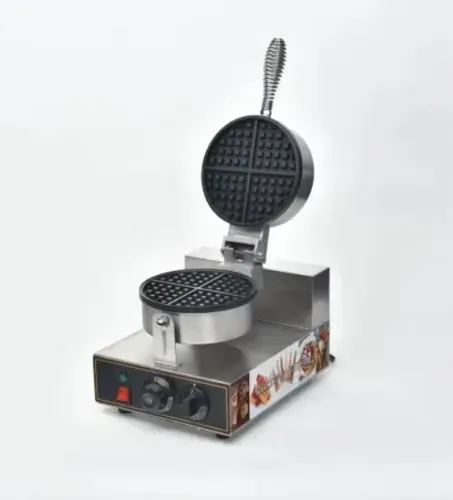
Ask whether the listed circular plate is only the baking surface or part of a complete forming system. Specify smooth, corrosion-resistant food-contact plates with accessible hinges, fasteners, chutes and gaskets. A stainless-steel outer body does not prove that every product-contact part suits bakery waffle cone equipment.
Compare coated and uncoated plates. Non-stick coating simplifies release, but metal tools, abrasive cleaners and overheating damage it; uncoated plates can last longer but demand better formulation and release control. Confirm that daily cleaning reaches every batter contact point without dismantling unsafe parts.
Before ordering a waffle cone maker in Nagpur, obtain connected load, phase, voltage, frequency, starting current, plug or terminal arrangement and protective-device requirements. Check the actual site supply and sanctioned load, then provide clearance and ventilation for heat and moisture. Test sealed packaging or covered storage too: Nagpur humidity quickly softens baked cones.
Use a Supplier Trial to Check Total Cost and Support
Accept a waffle cone maker only after it passes a continuous trial with your own batter, not after a few attractive samples. Run the machine through a full production period and record:
| Measure | Record |
|---|---|
| Cones | Saleable cones per hour and rejects |
| Shape | Average mass, mouth diameter, height, wall thickness, seam opening and tip formation |
| Appearance | Colour variation across the plate and between batches |
| Operation | Electrical load and cleaning time |
Check performance after the plates, operator and rolling station have worked continuously. Test cones after storage in sealed packaging or covered containers, because Nagpur humidity can soften wafers and increase breakage.
Ask for independent top- and bottom-plate temperature control, calibration instructions and a temperature-uniformity record from several points on each plate. A single thermostat can miss pale edges beside over-browned centres. Include the cone former, replacement moulds, ejecting parts, rolling tools and heat-resistant handling equipment in the quotation.
For bakery waffle cone equipment, obtain part numbers for heaters, thermostats or controllers, thermocouples, timers, hinges, coatings, fuses and relays. Request wiring diagrams, replacement intervals and written service response terms; a cheap machine becomes expensive during an avoidable stoppage.
Tajshree Bakery Machinary is one supplier to compare with alternatives for a waffle cone maker in Nagpur or a waffle cone maker for confectionery in Nagpur. Use identical batter, dimensions and acceptance records at every demonstration. Choose saleable output at your labour and storage conditions, not the highest temperature or cavity count.
Related product
 | Waffle Cone Maker ₹12000 Design Type: - Standard. Machine Body Material: - SS. Size: - 6-inch cone. View product → |
Frequently asked questions
How do you calculate the saleable output of a waffle cone machine?
Multiply the number of cavities by 3,600 and divide by the cycle time in seconds. Then subtract losses from dosing, handling, rolling, cleaning, changeovers and rejects.
How should you choose a waffle cone size?
Match the cone’s diameter and height to the scoop size, display space and pack dimensions. Check that the rolled cone holds the intended portion without tipping or crushing.
What process controls affect waffle cone quality?
Control batter weight, plate temperature, bake time and the interval between opening the plates and rolling each wafer. Test seam closure, colour, crispness and breakage.
What should you compare when buying a commercial waffle cone machine?
Compare cavity count, actual cycle time, power or gas use, plate access, cleaning time, changeover effort, reject rate, spare parts and technician support.
Keywords