Tray count alone will not tell you which oven will earn its floor space: tray format, usable spacing, bake time, peak demand, electrical capacity and labour all change the answer. By the end, you will be able to calculate the required output, compare four-, five- and ten-tray options, and request a quotation that reflects the real installed cost in Nagpur.
Key takeaways
- Calculate peak output using usable tray area, batch time and loaded trays.
- Compare airflow and tray dimensions, not tray count alone.
- Check electrical load, ventilation clearance and installation access before ordering.
- Request a commissioned bakery convection oven price based on your actual setup.
Calculate output before choosing five or ten trays
For a five tray or ten tray convection oven in Nagpur, start with peak demand: usable tray area × trays loaded per batch × batches per hour. Divide demand by this figure, then allow for product spacing, loading time, bake time and unloading labour.
A 16 × 24 inch tray is not interchangeable with a 400 × 600 mm, 600 × 400 mm or GN 1/1 pan. Confirm the tray format, rail spacing and usable chamber dimensions before counting positions.
| Option | Output calculation | Better fit |
|---|---|---|
| Four-tray HEB-4F | Four positions per batch, only if your trays fit | Small menus, lower peaks and limited staff |
| Five-tray RX-5D | Five positions per batch, subject to tray size and airflow | Regular production with several smaller batches |
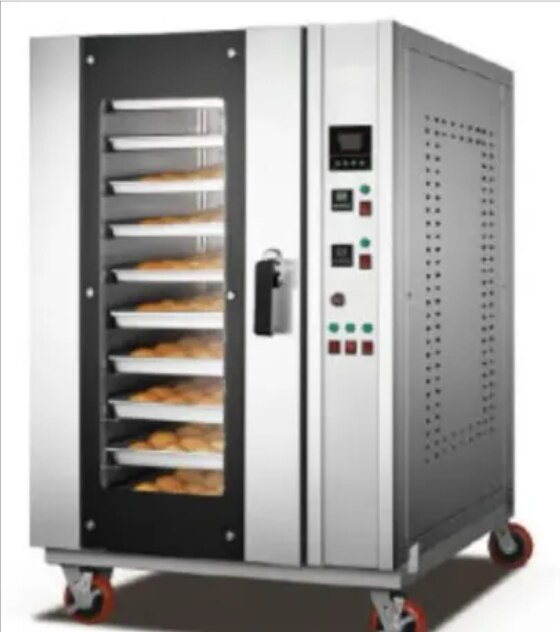
| Ten-tray RX-10D | Ten positions only when every level can load and bake evenly | Higher peak demand and enough labour to load quickly |
If one cycle takes 20 minutes, a five-tray oven produces up to 15 loaded trays per hour and a ten-tray oven up to 30. Product clearance, longer baking and recovery can reduce both figures.
Do not assume the ten-tray chamber doubles usable output. Cold dough, crowded pans or slow recovery can make its final levels bake unevenly, while a smaller oven may deliver more consistent batches. Compare your busiest hour, product mix and staff loading speed; choose ten trays only when the extra positions will be used.
Ask whether the HEB-4F, RX-5D and RX-10D accept the same trays, because model names do not establish compatibility.
Compare usable tray area, products and airflow—not tray count
A four tray convection oven can hold less total tray area than a five-tray machine, but tray count alone proves nothing.
A compact four-tray convection oven may use 435 × 320 mm or 460 × 330 mm trays, while an electric convection oven five tray may accept 400 × 600 mm or 600 × 400 mm bakery trays.
| Machine | Tray format to confirm | What it changes |
|---|---|---|
| Four-tray HEB-4F | 435 × 320, 460 × 330, or another specified size | Suits smaller batches and limited product runs; confirm whether it accepts 16 × 24 inch trays |
| Five-tray RX-5D | 400 × 600, 600 × 400, or GN 1/1 | Five levels can provide more usable area than four compact levels |
| Ten-tray RX-10 D | 400 × 600 or 600 × 400, with stated pitch | More batch output, but loading, recovery and airflow become more demanding |
A 16 × 24 inch tray is about 406 × 610 mm, so it will not fit every “five-tray” oven. Get the internal width, depth, rail spacing and included-tray dimensions in writing before ordering.
Product height also determines capacity. Tall loaves, cakes and choux need vertical clearance above the batter’s rise; shallow cookies allow closer tray pitch. Leave space around pans so the fan can move hot air across every surface, or crowded centre trays will brown slowly while edge trays overbake.
Calculate usable tray area × trays loaded × batches per hour, then reduce that figure for spacing, bake time and alternate-level loading. A ten-tray chamber is not ten times faster when cold dough causes long recovery or airflow cannot reach a fully loaded rack.
Match oven performance to loading, baking and cleaning work
Consistent baking depends on recovery time, airflow and loading discipline, not tray count alone. Specify the temperature range, rated kW, fan speeds, tray pitch and usable chamber dimensions.
Confirm whether the electric convection oven five tray uses dry heat, manual steam injection or a boiler; steam improves bread crust and choux but adds water treatment and cleaning.
Capacity is practical only when your pans fit without blocking circulation.
| Option | Operating advantage | Workflow risk |
|---|---|---|
| Five-tray | Faster recovery after loading; lower electrical demand | Less capacity during peak orders |
| Ten-tray | More output per bake; suits repeated large batches | Greater thermal mass, longer recovery and heavier loading |
| Four-tray | Easier for small teams and short runs | Frequent baking cycles can consume labour time |
Ask the supplier to prove how many 16 × 24 inch trays fit, with the actual rail spacing and included trays. Keep clearance around each pan; tightly packed batter or dough creates pale edges, wet centres and uneven browning. Test every rail position with your most sensitive product before accepting the oven.
Your staff also need a reachable door handle, readable controls, removable racks, a drain or wash-down arrangement and smooth, sealed corners. Record preheat time, recovery after a full load and cleaning time across one shift.
A nominal electric convection oven ten tray becomes impractical if loading needs two people or end-of-day cleaning takes longer than the extra output saves.
Check Nagpur’s electrical supply, ventilation and installation site
At 230 V single-phase, a 9 kW oven draws about 39 A, while a 15 kW oven draws about 65 A before voltage-drop and protective-device allowances. A five-tray model commonly needs 6–9 kW; a ten-tray model commonly needs 12–18 kW. Do not assume a normal commercial socket will support either machine.
1. Read the oven’s nameplate and request its required phase, maximum current, connected load, cable size, isolator rating and earthing arrangement. Many ten-tray ovens need dedicated three-phase power, so have a qualified electrician confirm the supply at your Nagpur premises before paying a deposit.
2. Check the voltage at the proposed connection during peak bakery operation. Low voltage can lengthen heat-up, trip protection and produce uneven baking. Ask the installer to allow for voltage drop and fit the specified protective devices rather than selecting them from tray count.
3. Obtain the manufacturer’s permitted ambient-temperature range and every ventilation clearance in millimetres. Keep the oven away from walls and heat-sensitive equipment, and provide the specified exhaust path or canopy. Air-conditioning does not replace oven ventilation.
4. Measure the doorway, staircase, floor area and service access before delivery. Reserve space for door swing, trolley movement, cleaning and access to fans, controls and electrical panels.
A hot, cramped room can destabilise controls and shorten fan, contactor and electronic-control life. Record these measurements and the electrical survey in the quotation so installation problems do not appear after delivery.
Compare bakery convection oven price on a commissioned basis
A bakery convection oven price is comparable only after every quotation reaches the same commissioned point in Nagpur. Ask each supplier to quote the oven, compatible trays, stand, freight, GST, electrical installation, water filtration for steam, operator training and warranty service—not equipment alone.
Request these fields in writing:
- Tray format and size, tray pitch, usable chamber dimensions, and number of included trays
- Rated kW, voltage, phase, maximum current, temperature range and steam method
- Commissioning tasks, warranty exclusions, spare-parts coverage and service response time in Nagpur
If you are comparing a five tray or ten tray convection oven in nagpur, insist on the tray format. Five trays could mean 400 × 600 mm, 600 × 400 mm or GN 1/1 pans; those formats cannot be treated as equal capacity.
Tajshree Bakery Machinary can help you turn tray compatibility, electrical work and commissioning into comparable quotation lines rather than hidden extras.
| Option | Commercial advantage | Choose it when |
|---|---|---|
| Four or five trays | Lower capital, power and labour requirement | Peak demand fits one batch, products change frequently, or floor space and electrical capacity are tight |
| Ten trays | More output per bake and fewer loading cycles | You have sustained demand, enough staff, extraction space and orders that keep the chamber full |
| Smaller oven | Less idle capacity and lower operating commitment | A ten-tray unit would spend much of the day partly loaded; that wastes heat, time and cash |
A four-tray machine is not automatically equivalent to a five-tray model: compare usable tray area, rail spacing and airflow before accepting the cheaper quotation.
Related products
 | Electric Convection Oven 4 Trays Electric Convection Oven 4 Trays manufacture in nagpur,wardha ,chandrapur ₹75000 ELECTRIC CONVECTION OVEN-4 TRAYS Model : HEB-4F Product Name : Electric Convection Oven Voltage : 220V/50Hz Power : 2.6 KW Net Weight : 39 kgs. View product → |
 | Convection Electric RX-5D Electric Convection Oven- 5 trays in Mahbubnagar, Nalgonda, Khordha, Dhenkanal, Cuttack ₹245000 ELECTRIC CONVENCTION OVEN RX-5D Capacity (number of trays) : 5 TRAY Tray size (mm) : 16 x 24” Dimension (mm) : 1370 X 910 X 890 Weight : 167 kg Total... View product → |
Frequently asked questions
How do I calculate whether a five tray or ten tray oven meets demand?
Multiply usable tray area by trays loaded per batch and batches per hour. Then account for spacing, baking time, loading time and unloading labour.
Should I compare ovens by tray count?
No. Compare usable tray dimensions, product spacing, airflow pattern, temperature recovery and the products you bake.
What should Nagpur bakeries check before installing an electric convection oven?
Confirm the required electrical load, phase and cable capacity, exhaust and ventilation needs, floor space, door clearance and service access.
How should I compare bakery convection oven price?
Request a commissioned quotation that includes the oven, trays, electrical work, ventilation, delivery, installation, testing and operator training.
Related product
 | Convection Electric RX-10 D ₹250000 ELECTRIC CONVENCTION OVEN RX- 10 D Capacity (number of trays) : 10 TRAY Dimension (mm) : 1320 X 930 X 1550 Weight : 253 kg Total power (kw) : 19 kW... View product → |
Keywords